

Key Person Insurance
Protecting the Critical Talent in Your Practice
Key Person Insurance is a type of business protection that enables your practice to safeguard against the financial impact of losing a clinician, manager, or specialist team member whose expertise, leadership, or relationships are essential to your organisation’s commercial success.
Speak to an expert
Content
What Is Key Person Insurance?
Key Person Insurance (sometimes referred to as Key Man Insurance or Key Person Protection) is a corporate-owned policy taken out on the life (and optionally the critical illness) of an individual whose absence would materially affect the practice’s financial performance or operational capability.
Core features:
- The practice (company) is both the policy owner and beneficiary.
- If the insured person dies or is diagnosed with a covered critical illness, the practice receives a lump-sum benefit.
- Funds are paid to the practice, not to the individual’s family, and can be used to maintain business continuity.
In clinical environments, whether private practice, specialist surgical unit, dental clinic, or group practice certain individuals contribute disproportionately to success through reputation, technical expertise, or patient referrals. The sudden loss of such a professional can jeopardise:
- Revenue streams and profitability
- Patient care continuity and trust
- Contract performance with insurers and referral partners
- Recruitment, onboarding and training costs
Key Person Insurance helps your practice hedge these financial risks and buy time to recruit, train, or restructure effectively.
A key person isn’t always the owner. Consider individuals whose loss would materially affect your practice’s financial performance, such as:
- Principal surgeons or consultants
- Lead dentists or orthodontic specialists
- Practice managers or clinical operations directors
- Senior clinicians with unique skills or specialist qualifications
- Revenue-generating referral partners
Ask yourself:
- Would their absence cause lost profit or service disruption?
- Could you recruit and train a replacement quickly?
- Are critical patient relationships dependent on this individual?
The primary benefit of key person insurance, from a tax efficiency perspective, is that it helps protect a practice financially while minimising tax disruption after the loss of a critical individual.
In many cases, the insurance proceeds can be received tax-free, allowing the company to cover lost revenue, recruit and train a replacement, or stabilise operations without creating an immediate tax burden.
This tax-efficient payout helps preserve cash flow and supports business continuity during a financially vulnerable period.
Key Person Insurance should be considered alongside other protection tools, such as:
- Shareholder/partner protection for buy–sell planning
- Relevant Life Insurance for tax-efficient death benefit for clinicians
- Income protection for key individuals
- Succession and continuity planning frameworks
A coordinated strategy ensures your practice remains resilient in the face of unforeseen personal and operational risks.
Key Facts in 90 Seconds
Don’t wait until it’s too late to find out who your most important employees are. Watch our video to see why Key Person Insurance is an essential business expense.
The Benefits of Key Person Cover
1. Tax-Efficient Payout
Key person insurance can provide a tax-advantaged payout, helping your practice cover lost revenue or hire a replacement without creating an immediate tax burden.
2. Business Continuity
The insurance funds help stabilise operations after the loss of a key individual, ensuring the company can continue running smoothly.
3. Recruitment and Training Support
Proceeds from the policy can be used to recruit, hire, and train a replacement, minimising disruption to the clinical team and workflow.
4. Financial Security
It protects the practice from unexpected financial strain, giving owners peace of mind knowing critical roles are insured.
How the Cover Works In Practice
- Identify Key Individuals – Assess which roles are essential to revenue, patient care or commercial stability.
- Structure the Policy – The practice purchases the policy on selected individuals, setting the company as the beneficiary.
- Premium Payments – Premiums are paid by the company; the payout goes to the practice if a claim event occurs.
- Claim Event – On the death or critical illness of the insured, the policy pays a lump sum to the business to cover financial impacts.
- Immediate financial protection for the practice
- Reassurance for staff and stakeholders
- The ability to continue trading during turbulent times
You have a few options:
- Let the policy lapse by stopping premium payments
- Continue the policy to term
- Transfer ownership to the key person
If the policy is written in trust (especially in partnerships), ownership may revert automatically.
- Paying wages and suppliers during a revenue dip
- Settling outstanding loans and debts
- Funding the recruitment of a replacement
- Supporting business continuity
- Providing employee or family support
- Protecting investor confidence
While traditional life insurance pays out to an individual’s family, Key Person Insurance is designed to protect the business. It’s about safeguarding your company’s future—not just offering personal protection.
Some policies include Key Person Life Cover with Critical Illness, providing comprehensive support for your business in case of serious health issues.
Many policies now include Key Person Insurance Critical Illness Cover, which provides a payout if the insured is diagnosed with a serious condition. With the average critical illness claim age being just 47, this addition is essential to protect against early, unexpected setbacks.
Ask yourself:
- How much revenue does the person generate?
- Could you afford to replace them quickly?
- Would losing them impact business loans or investor confidence?
- Would your team and client relationships suffer?
We can help you assess the right level of protection.
Key Person Insurance Cost
Costs vary depending on:
- Age and health of the key person
- Amount of cover
- Term length
- Whether critical illness cover is included
Tax and Financial Considerations
Key Person Insurance is typically viewed as a business expense. While tax relief on premiums may be available in certain circumstances, this depends on the purpose of the cover and accounting treatment — your Broadbench adviser and accountant should confirm the treatment in your specific situation.
Because the benefit is paid to the practice, proceeds are usually received tax-efficiently, helping preserve working capital when it’s needed most.
All statements concerning the tax treatment of products and their benefits are based on our understanding of current tax law and HM Revenue and Customs’ practice. Levels and bases of tax relief are subject to change.
FAQs
Who is a key person?
A key person is an individual whose skill, knowledge, experience or leadership contributes to the continued financial success of the business. A key person may be anyone whose death could lead to a financial loss for the business.
This might be a loss of profits if you lost your best salesperson, the cost of having to recruit or train a replacement or important personal or business contracts lost due to the key person not being there to maintain a contract.
Can partners take out Key Person cover on each other?
Yes, a partner could take out their own life policy and place it under trust for the other partners. In the event of a valid claim the policy proceeds would be payable to the trustees who would in turn pay the partners as beneficiaries of the trust. The partnership would usually pay the premiums.
What happens if the key person leaves or retires?
If a key person were to leave or retire before the end of the Key Person Protection policy term, the business could stop paying the premiums allowing the policy to lapse. Alternatively, the company may choose to continue paying the premiums until the end of the policy term and in the event of a claim, the business would receive a capital sum.
Who should be covered by Key Person Insurance?
The obvious choice of key person will normally be some or all of the partners or members in the business. However, it is worthwhile to consider the impact on the business of losing someone who may not have any financial stake in the business but nevertheless plays a fundamental role in its success.
Consider the individuals within your business and ask yourself:
- Would the loss of that person negatively impact or slow down any ongoing projects?
- How easy would it be to replace that person’s expertise?
- Is that individual essential to your business growth?
- Would the loss of that person detriment any customer or supplier relationships?
- Would the business miss their contribution?
- Are there any financial matters, such as bank loans that are dependent upon that key person?
If I don’t take out Key Person Insurance what are the consequences?
The consequences of losing a key person vary on the role of that individual and your business model. There are common factors to consider though, such as without the leadership of you or your key person your employees may decide it’s time for them to move on. Perhaps your customers may choose to go elsewhere and/or your sales revenue could fall. Potentially it could create a lack of confidence from your lender, suppliers, customers, and your other employees. Bank loans and overdrafts could be called in and your suppliers may demand payment upfront.
How likely is it that a Key Person will need to Claim?
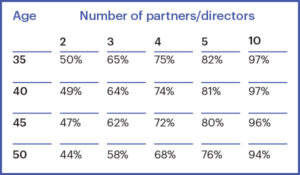
Likelihood of a Critical Illness – Likelihood of at least one partner or director getting a critical illness before age 65 Source CIBT02 Based on 1971-2003 population data and experience, published in SIAS paper Exploring the critical path, 2006. Males’ standalone, extended cover, including own occupation total and permanent disability.
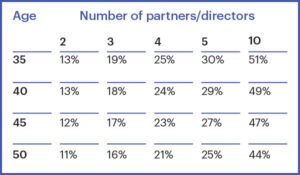
Likelihood of Death – Likelihood of at least one partner or director dying before age 65 Source www.actuaries.org.uk. Based on mortality data from TMNOO (temporary assured lives, male non-smokers, 1992-2002) at five plus years duration.
How much should I insure my key people for?
There are no hard and fast rules when assessing the financial value of a key person. Each key person must be dealt with on their own merits. A primary method of calculating the key person’s worth is as a multiple of the company profits, the standard multiples are 2 x gross profit or 5 x net profit.
Alternatively, some firms calculate the value as a multiple of that person’s salary. Up to ten times gross salary may be considered for a rapidly expanding business.
Your Broadbench adviser will guide you through this calculation.
What’s the tax position for Key Person Insurance?
Typically, tax relief is not allowed as in nearly all cases the key person being insured is a major shareholder of the business. Just because the policy may not qualify for tax relief does not mean that the company should not take key person insurance. It just means they will not get tax relief on the premiums.
Is it time to cover your key people?
Fill out the form below to arrange a time to speak to a Key Person Insurance expert.



